
DeKalb County Parole and Probation Compared
Parole and probation can both place a person in the community under rules, but they begin in different ways. The Tennessee Board of Parole makes parole decisions. Parole is conditional release from a state prison sentence before that sentence expires. Probation is ordered by a court and may start without a prison term or follow a period of split confinement. Split confinement means that part of a sentence is served in custody and the rest is served on probation.
TDOC Community Supervision carries out field supervision for both groups. That shared field structure can blur the difference, so the source of authority matters. A Board action supports parole. A DeKalb County court judgment or probation order supports probation. A jail release timestamp proves that the person left that jail at a recorded time, but it does not by itself show which form of supervision began afterward.
| Point | Parole | Probation |
|---|---|---|
| Who authorizes it | Tennessee Board of Parole | The sentencing court |
| When it begins | After Board action, approved conditions, and physical release | As ordered by the court, including after split confinement |
| Public person lookup | TDOC FOIL may show parole status and hearing information | TDOC FOIL may show probation status; the court file supplies the order |
| Field supervision | TDOC Community Supervision | TDOC Community Supervision |
| End point | Discharge or sentence completion under the controlling record | Court or TDOC discharge under the controlling order |
The terms used in a DeKalb County supervision record have precise meanings. Reading them as synonyms can produce the wrong conclusion.
- Parole
- Conditional community release authorized by the Board before a state sentence expires.
- Probation
- Court-ordered community supervision, sometimes imposed after a short period of confinement.
- Discharge
- The formal end of the active supervision or sentence status shown by the responsible agency.
- Absconder
- A person formally treated by the supervising authority as having left supervision without permission, not merely someone rumored to have missed a meeting.
- Detainer
- A request or legal hold that may send a person to another custodian instead of into the community.
Verify DeKalb County Post-Release Supervision
The public starting point is the Tennessee Felony Offender Information Lookup, commonly called FOIL. It covers current and former felony offenders in TDOC custody or under TDOC supervision. Search by exact name, TDOC ID, or State ID. A name search also offers supported fields for aliases and race, followed by CAPTCHA. Match stable identifiers before relying on a result, since people may share a name.
FOIL may show incarceration, parole, probation, or inactive status, along with location, offenses, sentence information, parole-hearing status, and release information. Use the label that appears on the selected record. An inactive status does not explain by itself whether supervision ended through discharge, sentence expiration, death, or another event. For that detail, ask TDOC for the discharge record or consult the originating court file.
- Identify whether the DeKalb County event was a county case, a TDOC felony case, or a transfer from the county jail.
- Search FOIL by TDOC ID when known. Otherwise use the exact name and compare the returned identifiers, offense, and location.
- Read the exact current status. Parole or probation points to community supervision; a prison location points to continued custody.
- For probation, request the judgment or probation order from the court that imposed it. The DeKalb Circuit Court Clerk serves Circuit, Criminal, and General Sessions matters, while city matters may use another clerk.
- For parole, distinguish a hearing schedule or recommendation from a final Board decision and an actual custody change.
- Call the assigned field office only after the record supplies a valid supervision link, and ask a narrow question about reporting or agency routing.
A broader search for a DeKalb County jail exit and its underlying record belongs in the DeKalb County released inmate search. Sheriff Patrick Ray's official DeKalb County Sheriff page supplies the jail contact when no TDOC status appears because FOIL does not cover every short local detention.
District 31 DeKalb County Supervision
DeKalb County does not have a DeKalb-branded TDOC field office in the state directory. The serving office is District 31 in Cookeville. This is a useful local distinction because an online search for a county-named office can send a reader to unrelated locations. The office spans more than one Upper Cumberland county, and an individual's release plan may identify a particular reporting place.
The official TDOC field-office directory is the source for the assignment and current contact. Its listing can change, so check the directory before a trip. The office should not be treated as a public name-search counter. Start with FOIL and the court or Board record, then call about legitimate reporting instructions or proper routing.
TDOC District 31
851 South Willow Avenue, Suite 202
Cookeville, TN 38501
Phone: 931-526-7165
Fax: 931-528-3267
TDOC's release-type material states that a probationer placed after split confinement must report within 48 hours. That is not a general deadline for every DeKalb County release. It applies to the defined probation route, and the actual order and instructions control. A parole grant also remains separate from exit because TDOC must approve the release plan first.
The image below comes from the official TDOC field-office directory.
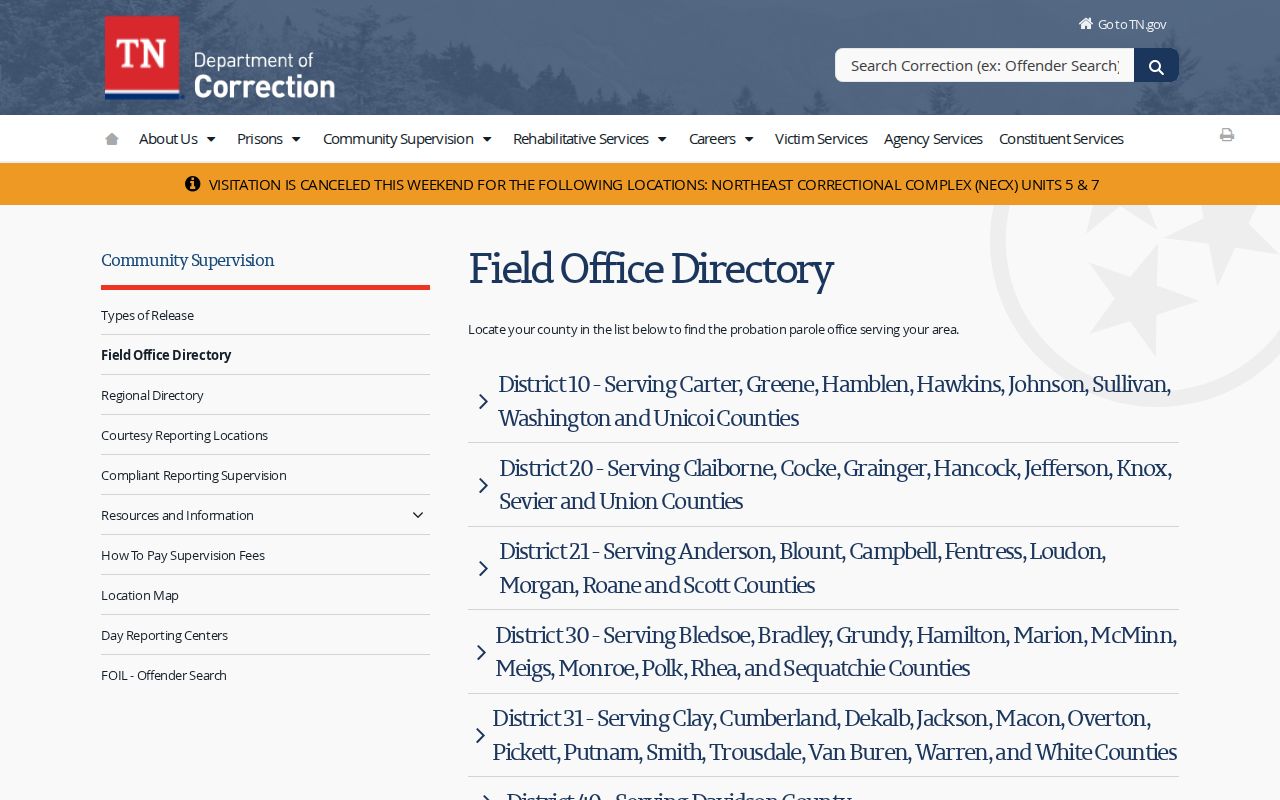
That directory is the official source tying DeKalb County supervision to District 31 in Cookeville, rather than to a separate county office.
DeKalb County Parole Hearing Records
The Tennessee Board of Parole publishes a parole hearing schedule page. State-prison and county-jail schedules are updated weekly on Monday, or Tuesday after a Monday holiday, and last-minute changes can occur. The schedule hub generally reaches about four weeks ahead. A listed hearing is a planned proceeding. It does not show that the person was granted parole or released.
Match the name and TDOC number, note the hearing type, and then check FOIL for the individual parole-hearing status after the event. No separate official public decisions search was verified. If the final decision document matters, contact the Board or make a focused public-record request. The Board can also provide schedule help at BD.HearingSchedules@tn.gov or 615-741-1150.
Hearing officers make nonbinding recommendations. Board members may adopt, change, or reject them. The official process states that three concurring votes make some final decisions, four are required for most violent offenses, and two can revoke. Hearing types include grant, revocation, rescission, time-setting, and appeal. A final revocation can revoke or reinstate supervision. These labels should be preserved rather than reduced to a simple granted or denied claim.
The appeal window is also distinct from a release date. Official grounds include significant new information, official misconduct, or a significant procedural error, and a request is due no later than 45 days after the offender receives the final decision. TCA §40-35-501 controls parole eligibility through offense, offense date, sentence, and statutory rules. Eligibility still does not prove a community release.
Note: Board schedules identify upcoming proceedings, while FOIL, VINE, and the release record are the better checks for a completed custody change.
DeKalb County Supervision Conditions and Violations
Supervision conditions come from the applicable court order, Board decision, release plan, and TDOC instructions. They can include reporting and other person-specific terms, but the DeKalb County research does not support publishing a single universal checklist. The sound approach is to obtain the controlling order and confirm current instructions with District 31. A past release record cannot show whether every present condition has been met.
A possible violation does not automatically establish an absconder or warrant status. No DeKalb-published absconder list or local public warrant list was verified. Missed contact, family reports, or an old web entry are not official findings. Confirm through TDOC, the Board, the sentencing court, or the agency that holds a warrant. If FOIL still shows parole or probation, record that exact status without adding an unsupported violation label.
Violations can lead to hearings that have different purposes. A preliminary or final revocation proceeding addresses continued supervision, while a rescission issue can arise before release is carried out. A detainer can also change the destination. Thus, a person may leave one agency and enter another rather than return to ordinary community supervision. VINE may report a new custody event, but it does not serve as a public supervision-violation or discharge register.
DeKalb County Release Property Receipts
DeKalb County does not publish a procedure for property pickup after jail release. Tennessee's county retention guidance still provides a distinctive records path. The CTAS schedule identifies the “Receipt for Property Returned to Inmates on Release” as a permanent record. It is described as witnessed and itemized, which can help corroborate that an actual release transaction occurred after a web roster or weekly link is gone.
Ask the sheriff narrowly for the property-return receipt tied to the relevant booking and release. Include the full name, booking date range, case or booking number if known, and the approximate release date. Do not assume the receipt proves why the person left or where the person went. Pair it with the release sheet for type and destination, and with the court or TDOC record for legal authority.
The CTAS sheriffs' retention schedule is evidence that this county record series can endure even when online material does not. It does not establish a local counter location, retrieval time, or fee. Those points must come from the DeKalb County Sheriff's Department when the request is made.
Note: Request the itemized receipt by booking and release identifiers; DeKalb County has not published a general property-return process online.
How DeKalb County Supervision Ends
Release from jail or prison and discharge from supervision are separate events. Physical release ends custody under one facility at that moment. Discharge closes the active parole or probation status under the governing sentence or order. FOIL may later show an inactive record, but inactive alone does not identify the closing event. Ask TDOC Records Management for the release or discharge detail when the exact date and type matter.
A DeKalb County probation case may also have a court record showing completion, modification, violation, or termination. Obtain it from the court that entered the order. The county clerk handles the county Circuit, Criminal, and General Sessions files, while a municipal matter may remain with Smithville or Alexandria. The Tennessee court directory filtered to DeKalb identifies the local clerks. Use the case number and party name so the correct office can find the record.
For parole, read the Board decision, TDOC status, and sentence record together. Sentence expiration, discharge, and an inactive public entry can occur in different documentary contexts. Preserve the agency name, exact field label, date, and time of the check. If sources conflict, compare their update times and ask the record-owning agency to explain its own field.
Tennessee Public Records Act access under TCA §10-7-503 is a route to a public discharge or decision record held by the proper agency, subject to exemptions and the custodian's lawful policy. Ask for a defined record by person, agency, and date range. Do not ask District 31 to perform an open-ended public name search.
Public Record Search
Sponsored Results